Tuesday, April 16, 2013

All roads lead to Rome

Apparently in every Italian city there are one or more gates, usually built during the ancient Roman days or rebuilt after the war, that indeed lead to the capital. Alex pointed out two Roman gates in Milan saying that you could follow a road straight down from these gates to Rome if you wanted to. He knows some people who have biked it. But I took the road that started from the Venetian gate. Rome is one of those places we all know as cemented in history. Rome was the center of the world. So much of our separate cultures in the west are related somehow to those started in Rome. I could not be more excited to explore this ancient of ancient cities.

Repubblica Teatro dell'Opera, a fountain I walked past
I don't know what this building is yet, but it looked really impressive, off of Via Plebiscito


I know it’s not a good habit to get your history lessons from HBO but a few years ago the television channel created a mini series simply called, “Rome” that followed the unorthodox story of a Roman soldier and at the same time portrayed the history of the Roman empire as it is passed through the hands of Julius Caesar after his victory over Pompey, and then his ultimate fall to the bloody hands of the Senators that betrayed him, to the epic battles between Mark Antony and Octavius afterwards as the empire slowly stabilizes. It’s not for kids, but it is one of my favorite mini series and really does romanticize (and doesn’t at the same time) the time period. Being in Rome at that time was like watching civilization evolve.

I woke up a little early because I wanted the chance to walk around Venice a little in the wee hours of morning, unencumbered by my camera and day pack, before I had to check out. I strolled through the quiet alleys, watching the actual Venetian residents doing much of the same thing. Shop keepers were setting up their displays, restaurant employees were writing the daily specials on their windows or chalkboards. I passed through a little neighborhood I hadn’t explored the day before. I stumbled upon a small grocery store, a local one by the look of it, and bought some peach juice, making my way out of the Venetian labyrinth and out towards the harbor. It was another gloriously sunny and warm day. I sipped my juice and sat on a bench in the sun, watching the boats roll around and the tourists start to awake from slumber. People watching here in Venice is kind of entertaining because everyone is a tourist doing touristy things like wiping sunscreen on the faces of squirming children, looking at maps, snapping photos. That and the scenery. There’s a lot to take in.

I made my way back to the hostel, thanked the owner, and checked out. I decided to walk through the city to the train station, no easy task (this city is very difficult to get around if you have a place to be. Since the alleyways are so narrow and the tourists numbers that fill them are so vast, you have to dodge people left and right as tourists tend to walk slowly and stop without warning as they glaze over windows of shops and get distracted by the smell of pizza and spaghetti in nearby trattorias and cafes), and eventually got to the station about an hour and a half earlier than the time my train was supposed to depart. I took a seat on the steps that lead out to the canal near the expensive and fancy water taxi stand and watched awhile as people hopped on and off. Eventually I made my way onto the train, took my seat in first class (this eurail pass is awesome) and watched out the window as the train rolled on. Our route on this incredibly high speed train took us through Bologna and Florence, both places I’d like to see if I’d have more time, and then ultimately to Roma Termini, Rome’s central station, but not before passing through beautiful Tuscan vineyards and countryside. I am still in shock and have been since the day I got off the train in Italy, about how absolutely beautiful everything is. Even the countryside is gorgeous. The southern, Mediterranean plant life is so drastically different to all other places I have been to on this trip, or ever. Everything is so green and alive here.

I rolled into the train station at about 5 in the afternoon. We’re in the south now so the sun stays up a bit later. My hostel is located just two blocks from the station, not a great area says a Firenzian I met in Venice. But, walking around the neighborhood, I saw nothing to be afraid of, this neighborhood is just another pleasant place, just nearer to the train station, a bit grittier perhaps and tends to be where the immigrants congregate. My hostel is located well above the street level in an apartment block it shares with local residents. The hostel is huge, clean, convenient, I can access internet everywhere, and its cheap. All of these things are tempting me to stay awhile longer. I quickly checked in, set up and settled in, and then headed right back out. I wanted to explore a neighborhood before settling down for the night. I chose to explore Trastavere, an area in the city’s southwestern corner. This area is supposed to be one of the more picturesque areas of the city and comes alive at night with locals. The alleyways here are filled with bars and restaurants, and a lively little plaza. I hopped the metro and got off as close as I could to Trastevere. I had to walk a decent distance but I didn’t mind, I wanted to get a sense of the city anyway. It’s definitely warmer here. People are now wearing shorts and flip flops as opposed to jackets and scarves. I wound my way across the Tiber River and into the heart of the neighborhood and to the plaza that centered around another old Roman fountain. People had gathered to sit in the sun and around the steps leading up to the fountain. I did the same. Then I noticed a church nestled into one of the corners of the plaza off to my left. I had read a little about it beforehand. It is the oldest church in Rome named after the Mother Mary, built in the 12th century. I went inside to have a look and realized that they were about to start an evening Sunday mass. I walked in and headed to the back where most of the tourists observing were. I took a seat in one of the back pews and attended the mass. The church was massive, much larger than it looked from the outside, and consisted of one large block held together by two lines of pillars that followed along the sides of the pews up toward the altar. There was a choir, a gorgeous choir, that sung nearly constantly throughout the entire mass, the priest from time to time talked over the choir. It was a cool effect. The mass was in Italian but I got the gist.

I don't know what this was either, but everything in Rome is picture worthy
A fine example of southern European plant life
After mass the sun had set and I was hungry. I wandered around Trastavere awhile and came upon a pizza shop that had a line out the door. I thought that was a good sign so I hopped in line to see what the fuss was about. The line eventually led to a counter where one woman was working serving out pizzas on display. They weren’t the typical round pizzas but huge sheets of pizzas, all different kinds, where the woman cut off chunks and people paid by the kilogram. I took a big slice from a pizza with some sort of mozzarella cheese, artichokes, green olives, and Italian ham, a thin coating of tomato sauce, and baked in olive oil. This was, hands down, the best pizza I had ever eaten. There is much debate, apparently, about whose pizza is better, pizza from the US or pizza from Italy. I think they both have their strengths. But what made this particular pizza the best I have ever tried was the freshness of the ingredients. The sheer Italian-ness of the flavors, the olives, oil, fresh vegetables, excellent dough, was probably why the line was so long. I don’t think it would be possible even to recreate this pizza in the US because we don’t have access to such Italian ingredients, at least ones so fresh.

I was satisfied with the meal and headed out to continue wandering. I found a small bar on a busy side street that was airing a Serie A league match between AC Milan and Napoli. I stayed for a beer and watched the first half of the match, tied 1-1 at halftime, and then headed out to walk back towards the hostel. I took the long way, a nice evening stroll, through the center of the city, up streets like Via del Plebiscito and Via Nazionale, passed by some really amazing things even though I have no idea what they are yet, I’ll be seeing them again in daylight I imagine, and eventually made my way back to the train station and to the hostel. An incredible day.

It’s now early morning on Monday. I plan to spend the day in and around the Vatican City. There is lot’s to see here!

Monday, April 15, 2013

...Polo

Venice is an incredible place. I’m writing this from the train I just hopped to Rome having spent the last two days in this beautiful Adriatic marvel of a city. But I wouldn’t live here. And actually I don’t think any Italian people live here either. The tourist to resident ratio must be somewhere in the vicinity of 100:1. And that impacts the experience in a negative way, at least for me. I can’t say too much on this. I’m a tourist too. But it’s not just the number of tourists that bother me but the money grabbing trends that affect the touristy areas, like restaurants, shops, bars, etc. And since the entire island is touristy, there are very few places you can go without someone trying to rip you off or anywhere to find a bit of quiet. Also, Venice is a place you go only if you have money. Or it’s a place you stay for a little while if you have money. For budget travelers, this place isn’t ideal because there is almost no way to live cheaply, to save money like you can in any other city. There are no cheap markets or shops (well there’s one supermarket hidden away in some alley but it took me a long time to find it). So Venice, for budget travelers, is a place you spend a day or two to get a sense of the place. If you don’t mind spending money though, this place is for you. Gondola drivers will sing to you in an evening stroll around the canals, waiters will serve you some of the best wine in the world, and you can take private boats anywhere in the city. I’d come back here someday if I’m made of money.

The entrance to my hostel hidden in the depths of Venice
A typical shot of a Venetian canal
But don’t get me wrong, Venice is amazing and is worth a visit. If I had more time and had planned a bit better, I would have been able to find these smaller, less touristy places around the island. And Venice really is an absolute miracle of architecture. There is a reason this place attracts so many tourists. It really is that beautiful.

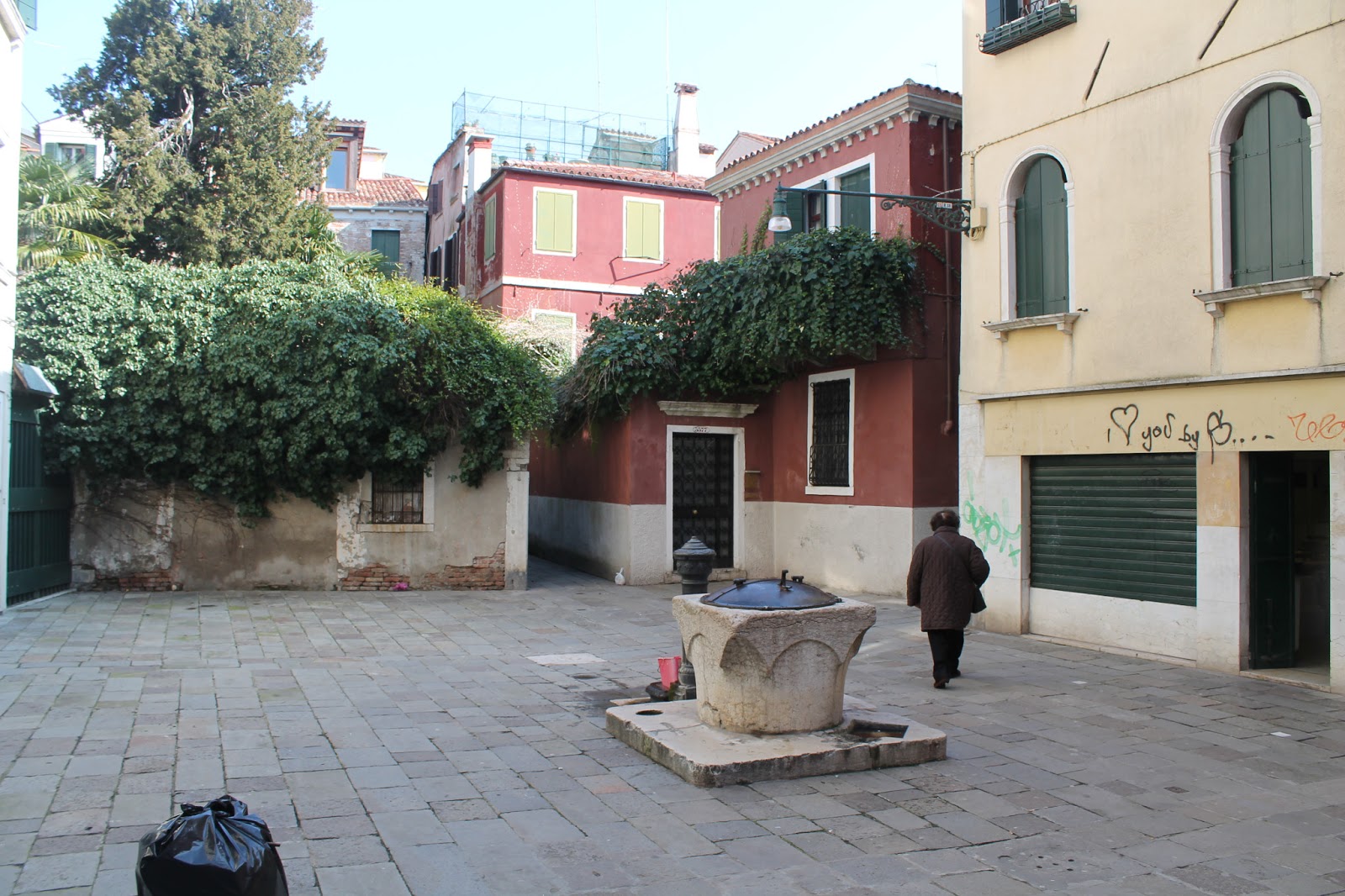
The small plaza outside my hostel, an old Roman fountain in the center
Some more Venetian architecture, every building in the city looks like this
Back then to a couple of days ago when I first arrived. It was around three in the afternoon. I had just taken the train from Milan and I was very excited about Venice. Venice to me, before I arrived (and also afterward actually), brought about images of scenes from the Bond film, “Casino Royale”, towards the end of the film where Bond quits the service and takes a private sail boat into Venice with Vesper, his accountant and lover. It was a very romantic set of scenes. Of course things go poorly for Bond, they always do. But at least he was in Venice! I walked through the station, down the sloping steps and into this small square abruptly met by the Grand Canal. The square and surrounding buildings were colored marble white and the water in the canal was a milky turquoise color. Boats zipped around the water, picking up passengers, dropping them off, touring around. But they weren’t just boats. They were all those Italian luxury boats, the small, long ones with an open top, wooden panelling, and golden and silver trimming, with little Italian flags flying in the back and drivers with sunglasses and white collared shirts. My goal was to get to the hostel. I had read reviews of this hostel before booking, as I always do, and the only negative feedback that people left was that the hostel was really very hard to find. So I spent a lot of time preparing maps and going through the route in my mind ahead of time to avoid any confusion and extra laboring when I arrived. But, yeah, as I said yesterday I got lost. Pretty quickly too. And really lost.

Each wall featured unique windows, shutters, and here, a statue
The main tourist area along the harbor not far from my hostel
I hopped the water taxi, as was instructed, and was supposed to get off the boat at the San Zaccaria stop on the other side of the island. The grand canal makes a backwards “S” route through the middle of the island and my stop was at the end of the “S”. But the water taxis also go around the outside of the island as well. I hopped the boat going in the wrong direction. But I didn’t realize it. I disembarked at a stop that I thought I remembered reading was near to the stop that I was supposed to get off thinking that maybe it was smarter to get off here because I also thought that I had taken an express boat and was going to pass over San Zaccaria, if that makes sense. But, nope! I got off at a stop clear across the wrong side of the city. I also made one of the biggest errors you can make in navigation which is to keep going on, hoping you’ll be able to recognize something eventually. I did not recognize anything ever. But the city is so beautiful and I was so distracted by everything around me that I didn’t really care that I had no idea where I was going. But my pack was really getting heavy. And the sun was shining and the sky was warm and I was beginning to sweat which can be pretty unpleasant. Eventually I sat down on some steps and took out my computer which had a downloaded map of the city. I eventually oriented myself a bit and located myself on the southern edge of the city, pretty far from where I needed to be. Another hour or so of wandering through the back alley streets of Venice and I finally found my hostel.

Gondolas for hire in the harbor
The city was full of these small Madonna shrines in alleyways
The city of Venice can easily be characterized by its waterways and canals. As I said before, there are no roads in the city and therefore no cars, motorbikes, bicycles. You can either get around by boat (easily because there are so many canals that intercross and wind through the city that you can literally get anywhere from the water) or by foot. Most people get around by foot (boats are expensive). The widest pedestrian roads are still alleyways and hidden between encroaching ancient buildings. It is no surprise that people have a hard time finding the hostel. Five minutes of walking anywhere and you’re immediately lost again. Every alleyway has a name but they are all so short and change so frequently that it’s not very helpful. And if you don’t have a good map of the city (which I didn’t at first), then getting around is nearly impossible. Every canal is filled with dreamy gondolas and private yachts and hold that same creamy turquoise sea water as described before. They wind through dense neighborhoods and buildings are built right up to the edge of the canals. So you could hop out of your window and straight into a boat if you wanted to. Every building on the island is beautiful. Each is unique but they all have similar qualities such as small terraces with overhanging vines and flowers, ancient windows, shutters, and doors. Churches dot the island as do ancient bell towers and madonna shrines. Many small plazas are formed by intersecting alleyways and are centered around ancient Roman fountains in the shape of dogs’ heads or human heads spewing public water through their mouths. And there is absolutely no rhyme or reason to the way the alleys twist and turn which is why getting around is so difficult. And the entire island is all like this. I cannot describe here accurately how absolutely beautiful the city is. You kind of have to just take my word for it. And Venice is also famous for its carnivale, where people dress in those famous Venetian masks and costumes. Stores sell the masks and these old Venetian puppets.

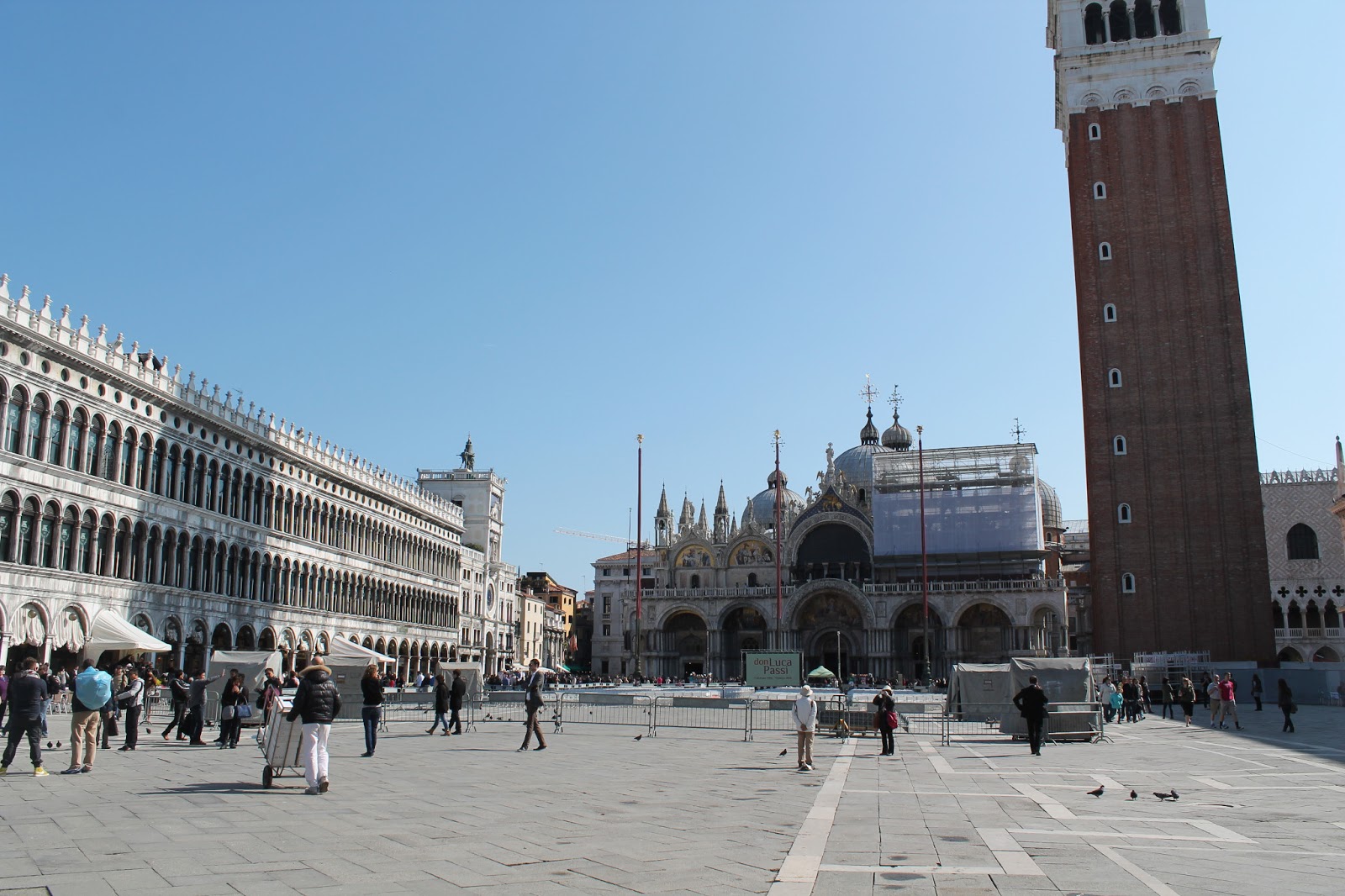
Piazza di San Marco, all towers in this city are crooked
Some classical musical entertainment for fine diners
I spent my first evening wandering around the Piazza di San Marco, one of the largest plazas in the city. There were outdoor sitting areas for fancy Italian restaurants where live classical bands played old Italian music out in the courtyards of the restaurants. The sun was setting over the plaza and on the hour bells could be heard tolling the time in all directions around the plaza and across the island. I wandered through some of the alleyways behind the plaza for a couple of hours, and, still mapless, got hopelessly lost on the northern edge of the island, but luckily stumbled upon one of the city’s only supermarkets. I bought a couple of cheap beers, Italian Peroni, and headed back to the hostel to settle in for the night.

More gondolas for hire in the Grand Canal
Buildings in Venice are built right up along the canals
The hostel is set deep within one of these alleyways just behind a quiet plaza with its own fountain. This hostel is really nice, quiet and comfortable. I met three Canadian women here, all of them traveling individually, and a cool French guy who brought some really excellent whiskey from South America. He said he always brings one of these bottles with him whenever he travels. He gave us each a glass and it tasted of smooth vanilla, very nice stuff, and I told him it was a good way to make friends. He agreed. We stayed up late chatting before I turned in.

A look out from the northern coast of the island, mountains in the distance in mainland Italy
A closeup of some of the gondolas in the canals
I woke up relatively early, made some breakfast of taralli and water, and made some coffee. The hostel has this really cool coffee maker, one I have never seen before. It’s really just a metallic pot with two chambers, an upper and lower one, that screw into each other. In between them is a metallic filter and small container where the coffee is put, grounds that had been grounded into a powder. You fill the bottom chamber with water and then you put the whole thing on the stove to boil. The boiled water eventually turns to steam and the steam rises up and out of the bottom chamber, filtering through the coffee powder, and collects as really strong coffee in the upper chamber. Then you just pour a cup from the upper chamber. Cool, right? Anyway, I had planned to stay just one full day in the expensive city, two nights. I decided I would spend the day wandering very slowly around the island by foot using the Grand Canal as a guide. I started back at the Piazza di San Marco, and wandered around the plaza awhile, people-watching in the bright morning sun of daylight. I wandered out of the San Marco area and, winding through the busy alleyways and crossing up and over canals, made my way up to the Jewish Ghetto in the northwestern edge of the city. The Jewish Ghetto was a little quieter and less touristy than the rest of the city. There were kosher restaurants here and I came across one very long table, set outside in the sun along a canal, where Orthodox Jews shared a meal. It was pretty cool. Then I wandered back along the Grand Canal to the train station where I reserved my ticket to Rome. I dipped down back into the heart of the city near the middle of the “S” to a plaza where I got a cheap slice of pizza for lunch followed by some stacacchia gelato on a cone, very nice. I took a look into some of the buildings and churches in this area. Many of them allowed for free access. Some of the buildings would host concerts in the evening that you could reserve tickets for, classical concerts playing Venetian music. It would have been nice but the prices were too high. I found an interpretive art studio, walked around that awhile. And then I wandered down to the southern edge of the city along its coastline. Here too the water was full of boats and off in the distance lay another long island where more beautiful Venetian buildings and churches could be seen.

A narrow canal in the city
The city was dotted with stunning churches
I had been walking for hours at this point and I was getting a bit tired. I wet back to the hotel, sat down with the Italian owner in the kitchen for a beer, and rested awhile. I went back out that evening for a meal at a small pizzeria by the water near San Marco. This was the only place I could find that I knew wouldn’t charge me anything too absurd. I walked around the plaza again in the twilight of evening and then retired again to sleep.

Some laundry hanging to dry in the Jewish Ghetto
How old is this door do you suppose?
The next day, the day I am currently in, was eventful enough that it deserves its own post, I think. So I’ll end this one here in Venice. I did some planning for the future of my journey here in Venice as well. Lissy, the friend I stayed with in Berlin, has some time off next week and is meeting me in southern France to do some traveling. I am really excited that she could come down to meet me and it will be nice to have a traveling companion. So for Italy then, I’ll probably stay in Rome for most of next week and then either leave Rome for Nice, where I’m meeting up with Lissy, or try to spend a day or two in Florence before heading out to France. I’ll see how much I enjoy Rome, I guess.

A look out towards San Zaccaria from the southern portion of the island
Oh, by the way, Marco Polo was from Venice. Fun fact.

That’s it for now. See you in Rome!

Saturday, April 13, 2013

One of you will betray me...

I slept in. The bed was so warm. Pietro and Anna both had to get up early and go to work and Alex sleeps like a zombie, deciding to wake only when I awoke. I quietly walked over to the bathroom to take a shower and looked out the window. The Zoncas live on the top floor, the 8th floor, of their apartment building and the view from the bathroom window looks out towards the city center. You can see the Duomo through the hazy, humid sky. The morning was gorgeous. A little overcast but warm. And the view out to the city beyond from this window was no different then the view from the city from atop the Duomo from the day before. I’m getting the sense that all of Italy is this pretty and picturesque.

After getting ready for the day, Alex and I left the apartment and hopped a tram to a cafe for some breakfast, Cafe Titanic, one of Alex’s favorite places for an early meal. We both had pastries, mine filled with a marmalade jam and his filled with cream, and cappuccinos, a good breakfast coffee. Then we walked back to the Piazza del Duomo and then a bit further to go explore the city’s castle. Long before Italy was united in the 19th century into one state it was split into many regional states. One of these was Milan and the Lombardy plain whose capital was here in the center of Milan and whose king and royal family resided in the beautiful and distinctly Italian style castle. When one thinks of castles one usually conjures up images of tall English castles with towers, damsels, and dragons (or maybe I’m just generalizing that assumption, that’s what my mind conjures up in any event). This castle looked more like a gigantic southern villa. It centered around two very large square plazas bordered by high walls within which was the castles interior. The walls were made of brick and glazed over with stucco siding to which paintings and murals and mosaics were fixed. The tops of the walls had walkways for leisure and probably for guards and sentries. And above the walkways were the same Italian style red tiled roofs that you see all over the city. In the plaza were large, lush, green grass fields and gardens bursting with colorful flowers and ponds and fountains. The air was mild enough for bugs and butterflies to buzz around. Below the plaza were canals that moved water around, supposedly for plumbing and as water sources for the inhabitants. It was kind of a magical place.


We stumbled upon this photography exhibit, part of design week Milano
The best photograph I have of the castle, I should have taken better ones...
We walked through the castle to the other side and exited to a large park of much the same thing. We walked very slowly, enjoying the occasional glimpses of sun in between clouds and watching the ducks in the small ponds. Many Milanese were doing the same. But we were getting hungry for lunch. So we walked back to the Duomo, caught the tram back towards the south (and in the direction of my surprise!) and got off near the Zoncas’ neighborhood and found a small local pizza place for lunch. The shop had a small bar with a display of the various prepared pizzas and a small counter opposite the bar for sitting. Each pizza looked amazing and had been prepared with Italian ingredients. We both ordered a slice with mushrooms, artichokes, capers, and olives and both got a coke from a tall, thin can. It was a tasty meal. Our stomachs satisfied with our lunch choice, we started walking towards the Chiesa di Santa Maria delle Grazie, a monastery, where my surprise awaited me.

We ate lunch here, Breadly, a small pizzeria
My half eaten pizza with Italian meat, artichokes, capers and olives
We got to the church and I immediately knew what I was in for. We walked around the small church first, part of a Dominican monastery, and Alex, knowing a lot about architectural design, explained that the church, and many other churches in Italy, was built in the shape of a cross. The entrance to the church was like the bottom of the cross shape and the altar was located where the two lines of the cross intersect with the three other points extending outward from the altar and hold more pews and the choir stalls. The top of the church was formed in the navata style, like an upside down boat. The church was elegant and quiet, very peaceful. But the real reason people come to this monastery is to go visit the Cenacolo Vinciano, the refractory, to see Leonardo Da Vinci’s famous Last Supper painting. Most people that I know that have visited Milan have all gone to the monastery to try and see the painting only to have been disappointed and turned away because they had needed to make prior reservations. I didn’t bother either because usually the reservation needs to be made weeks in advance. But Anna, the night before, searched for tickets and two luckily appeared, and she quickly reserved them and Alex and I showed up at the appointed time.

No photos allowed at the Last Supper, but here's proof I went
The painting was one of the most impressive I have ever seen in person. It depicts the scene of the last supper, of Jesus and his twelve apostles sitting beside him on a long table. The scene shows the reactions of the disciples just after Jesus makes the announcement that one of them is about to betray him. All the disciples are in a fit of shock and confusion, questioning whether they are the ones that could be the betrayer. I had an audio guide that explained that the painting is in dire need of constant attention and preservation because Leonardo decided to paint directly onto the surface of the wall which allows the sharpness of the contrasting lines and colors to shine more acutely. But this method doesn’t last as long as a fresco painting. So much of the painting is crumbling or faded. But even still, the painting is a masterpiece and seeing it in person was a privilege. I thanked Alex for taking me and then we walked out.

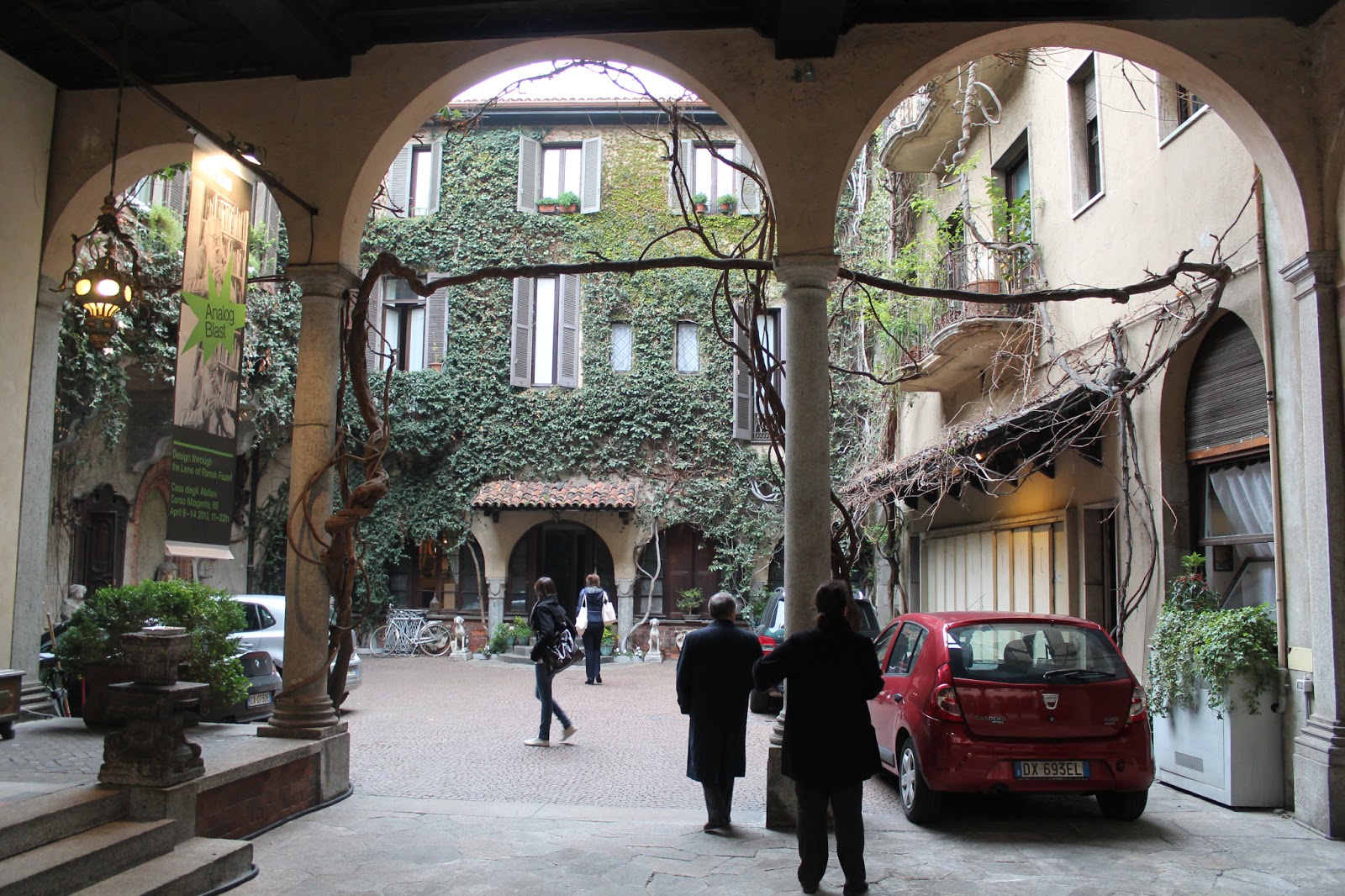
We strolled around for a bit and stumbled upon some more design exhibits. We walked into the courtyard of one building because we thought it was beautiful and worth a look and it turned out that there was a free photography exhibit inside. But more interesting to me than the photos was the building and house itself. We learned after talking to one of the guides inside that this building once housed Leonardo Da Vinci when he came to Milan to paint the Last Supper. The house was incredible. The courtyard in the front was filled with damp moss and ivy and old Roman statues and faces and fountains. The back of the house led to a yard centered around a fountain and had lush grass lawns and gardens. It must have been a nice place to come, sit and think.


The courtyard that drew us in to Leonardo's Milano residence
The courtyard was full of plants and old Romanesque statues
A view of Leo's inspirational backyard
We went in to view another one of design week's photography exhibits
We walked around a bit more, got some coffee and gelato, but we were getting a bit tired of walking around for so long so we hopped the tram back to Alex’s apartment. Dinner was waiting for us. Pietro and Anna had prepared an excellent home cooked meal of focaccia bread, olives, and salami to start followed by a course of risotto with mushrooms, followed by another course of veal covered by a tuna and mayonnaise sauce and finished with some local greens and balsamic vinaigrette. We had some local fruit that tasted like a cross between an orange and a pear and some local Italian pastries from the market. It was a stellar meal. The Zoncas were so kind to spend all the effort in preparation for me and I was grateful for the meal and the authentic Italian experience. It didn’t take long for us to get sleepy and crash for the night but before I did, Pietro helped me come up with an itinerary that would take me through the best parts of northern Italy. I was grateful for the local insight.

I didn't take photos of the meal, but at least I remembered the pastries!
But I left the Zoncas and I left Milan this morning. I hopped a train to Venice, a city along the northeastern coast, a city famous for its lack of roads and winding canals. The train took about two hours, the city is very close, and besides all the trains in Italy are ridiculously fast. The train zipped through beautiful Lombardy plain countryside and out to the coast, over a long bridge extending out into the sea, and then eventually to an island off in the distance. Actually, Venice is a grouping of islands. Walking out of the train station you immediately get a sense of the place. The steps of the station extend out to the Grand Canal, the city’s major thoroughfare. Ancient buildings extend right up to the water. The whole place is a miracle of architecture and construction. The city has no roads and therefore no cars. All transport is by boat or gondola or by foot. And the day was sunny, warm, and the city smelled like the sea, my absolute favorite smell in the world, the salty air hanging in the warm sun. I hopped the local water taxi that makes runs along the canal and got off and wandered through the dense and imposing alleyways that make up the city towards my hostel. I got lost. I got really lost. But I had plenty of time and wandering around was kind of nice. Eventually I found my bearings and wound my way up to the hostel, located in a back alley of a back alley of a side canal off a canal off the main canal. The route to get there takes you deep into the heart of the small city, around some ancient Roman fountains still spewing drinking water for locals, and through many small turns and twists until you reach the door that leads you up several steps and floors to the hostel. The place is beautiful and laid back. I settled in and then walked around some more, got lost, and returned to the hostel. I wait until the next post to give you a real sense of the place. But Venice is the kind of place that you dream could only exist. I have the day today to walk around, get lost some more, and explore. Hopefully I make it back!

Friday, April 12, 2013

Milano

I got off the train two days ago around 9 in the evening to a large, dark station in central Milan. I was wearing a spring jacket over a light, zip up sweatshirt and a scarf. As soon as I stepped onto the platform I was met with a wave of mild, moist air and I instantly began to sweat. Even in the dark of evening did the humidity hang in the tepid air of the train station. I don’t normally like humid weather but the moisture that met my skin after months of dry, icy conditions was very welcome.
 
I wandered my way through the large train station, announcements were made in Italian announcing the arrival and departure of trains (Italian is a very attractive language, even from train announcement robot women), and I made my way down to the lower depths of Centralle to the metro station. The hostel was pretty easy to find and unlike Hamburg, I had done my homework and prepared some maps on my iphone. The hostel was located on a very quiet street in a residential neighborhood in northern Milan. I made a short walk from the metro station through dense alleyways with high building fronts dotted with windows and balconies with overhanging vines and flowers. Every single building looked as if it had been there since ancient Rome. I walked through an entryway that led to a gated courtyard where my hostel was located. I was buzzed into the front door and I made my way up the steps to reception.

The hostel was located across several apartments on two floors of this building. Everything looked old and authentic but the place had the dank grittiness of a very cheap hostel. The reception was crowded with people complaining about whatever in broken english to the single hostel employee behind the counter. I waited about 20 minutes for my turn. Eventually I checked in, settled into my zoo of a dorm room, and went up to the kitchen to skype. I’ll now backfill you on some decision making on my part prior to my arrival to this hostel. Milan is hosting a special design and fashion week, one it holds annually and is world famous, and so all the prices in all the city’s hostels and hotels have spiked significantly. So much so that I considered skipping Milan altogether because of the dent in my travel funds that it would have created. This hostel though maintained a reasonable price even after it had been hiked. But I had to cope with its 50% satisfaction rating that it received on hostel booking websites, which is pretty low. So I kind of knew this place was going to be gritty, no big deal. Exhausted from the trek and late arrival, I crashed for the night.

I had made plans ahead of time to meet up with Pietro Zonca, a friend of my family that we had known from home. The Zonca family moved from Milan to Burlington for a few years for work and now are back in Milan. Pietro had graciously taken the day off to show me around the city and we were meeting out in front of the hostel at 10 in the morning. It had taken me some time after waking to get my affairs in order. The reception guy was pretty useless. I tried to reserve another night but he said there was no guarantee for a bed as if there was no way he could check whether they were booked or not. This place was kind of a mess. So I left my bags at reception, assuming I would come back in the evening to check in again and stay another night. And I was starving and it was close to 10 so I quickly left the hostel and made my way towards a small market shop nearby. It was gloriously sunny, the sky was blue, and it was very warm. All the annoyances from reception were quickly wiped from my mood and I pretty much skipped down the street towards the shop. The shop was a pretty traditional Italian one (although I guess they all are) and I bought a package of taralli con peperoncino (like cracker circles baked in a spicy pepperoni oil) and a large bottle of Pellegrino for a combined total 1 euro 50. These items would go for much, much more in the North End at home. Then I walked back towards the hostel’s courtyard entrance to meet up with Pietro, munching on my taralli. Pietro arrived a few minutes later.

Pietro is a short, well dressed Italian man in his 50’s, very smart, and bursting with happiness and excitement. It was really good to see him again. The last time we had met I was much shorter. We started walking towards the city center, it wasn’t too far from my neighborhood, and we caught up awhile, chatting as we walked. We took the scenic route along Corso Buenos Aires, one of Milan’s famous shopping streets. Milan, along with New York and Paris, is one of the premier cities for high end fashion and luxury and this is plain to see when you see all the people walking around and how they are dressed. Everyone from children to the elderly were dressed in fine clothes, clad in black or gray or other muted colors. Pietro was explaining to me that Italians consider black as elegance and so most of Italian fashion lacks color. And despite the mild weather, most people wore coats and scarves (although I could have walked around shirtless the weather was so nice). We passed high end shops like Gucci and Louis Vuitton and Miu Miu and all the others. We passed squares and plazas all bustling with crowds and people sitting on benches, chatting in the sun. We passed by one plaza where Pietro explained to me they displayed Mussolini’s dead body after he was killed following the war.

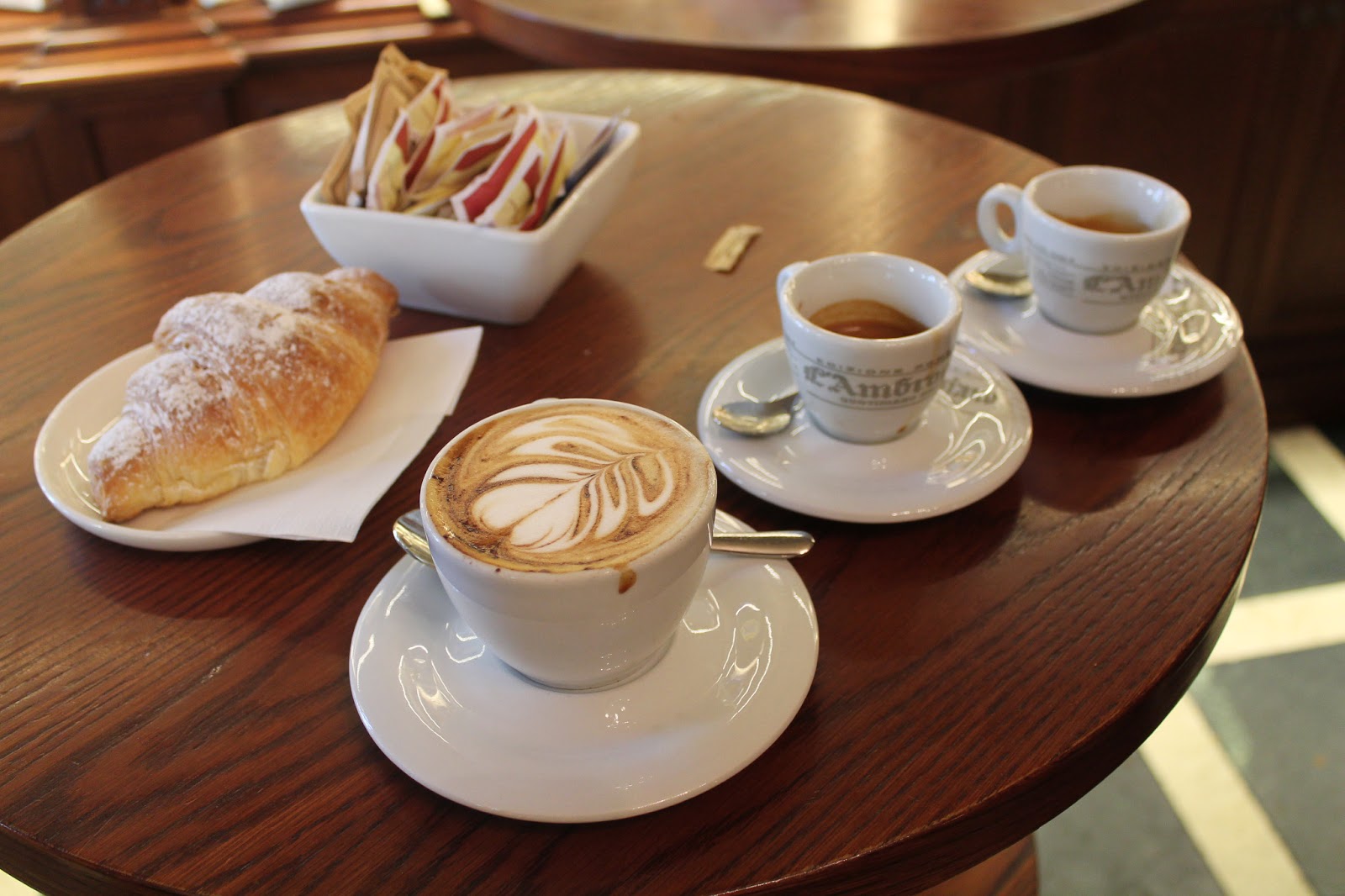
As we walked, Pietro talked a lot about Italy’s troubled past, its current economic woes, and why Burlesconi and the current political figures are troubling for the country’s future. It was really interesting to listen to him talk. But eventually all the political discourse gave way to a desire for coffee. I was all too eager to try my first Italian espresso and Pietro, he explained to me, is a coffee addict, so we ducked into the first coffee bar we saw. This and all coffee bars in Italy are unlike all others that I have been to in the world.  And I too am a coffee addict and have lived in such places as Seattle, so I’ve seen my fair share of coffee shops. These bars are very small, have only a few high tables for standing, and most people order and drink from the bar. There are usually just one or two well dressed barristas and the menus are always the same and are very short and to the point. Long gone are the hip cafes of Berlin and Scandinavia. These bars are all about the coffee. We ordered two coffees, which are espressos in Italy, and come in very small coffee cups that look more like tea cups, and only include the smallest volume of liquid. You wonder what’s the point and then realize after sipping that the intense flavor of coffee only requires a small amount. And the espresso was by far the best coffee I had ever tasted. I added a bit of sugar and it was perfect. The culture dictates that you go to the bar, order an espresso, pay your euro, sip the espresso, and leave the bar. Quick and easy and wholly satisfying. But for good measure I tried one of the pastries as well, a cream filled Italian pastry. Molto bene!


One Italian pastry, one Italian cappuccino, and two espressos
Pietro, my friend and guide through Milan
A typical side alley off of the main shopping street of Corso Buenos Aires
We had a snack of dough stuffed with mozzarella and tomatoes here
Then we walked a bit further to Plaza de duomo, the city’s central plaza and home to Milan’s main attraction, its massive cathedral. The cathedral soars high into the sky and looks a bit like the castle at Disneyworld. It’s made entirely of marble and contains over 1600 unique statues along its exterior. Hundreds of individual spires shoot into the sky and as we walked closer, we could see glimpses of its beauty through the dense cover of lower level buildings with red roof tiles and stucco siding. The plaza itself is huge and thousands of people gathered in it to lounge in the sun. The place was teeming with activity. We bought the entrance tickets to climb one of its towers to the cathedral’s roof where we could get views of Milan’s skyline. Milan doesn’t have many tall buildings and the cathedral itself is so tall that we got a full 360 degree view of the sea of buildings below that extended out to the plains in the distance. The buildings below were a beautifully monotonous sea of red tiles and easter color stucco walls. Each rooftop had a balcony with a garden and old women watering plants. It was everything you would hope the Milano skyline would look like.

The duomo, Milan's central cathedral
The duomo is made up of hundreds of these spires topped by unique statues
After gazing awhile at the dreamy skyline we climbed back down to meet up with Alex, Pietro’s son, in the plaza. The last time I saw Alex I think he was 12ish and now he’s 22, so a bit different. Alex speaks English very fluently and with an American accent, having learned it from scratch in Massachusetts. He now studies three dimensional computer animation at a design school in the city. The three of us continued to walk around the central area of Milan. We got gelato, the Italian version of ice cream, a smoother, creamier version - truly excellent stuff. We stopped off at the local Lomography shop so that I could get my camera looked at (I had a small problem with the mechanics of the camera but they fixed it post haste!) and then we went back into the duomo to take a look at the inside of the cathedral, free of charge.

Me spinning three times on a bull's balls, a local tradition that means you are destined to return
We got gelato here, mine of mint, Jamaican rum, and cream
The duomo looks big from the outside because it is big from the outside. But there are lots of buildings that look big from the outside and then you go in them and they look normal because the insides are divvied up into separated rooms. You kind of assume that the duomo is the same. But then you go inside and realize that there is exaclty one room in the duomo and that the entire building is completely hollow. I’ve never seen a bigger interior space. It’s not easy to describe but you walk in and your jaw drops a little as you gaze at the sheer space. And of course it is beautiful too. We wandered around the cathedral for awhile, slipped down in to the crypt, and then exited back out to the plaza. I left Pietro and Alex for a couple of hours as they went to get their teeth cleaned (an appointment they had made a long time ago) and I went to go buy some spring shoes to replace my inappropriately heavy winter boots.

The canal in the south of Milan, a popular area for locals
I met up with Alex a few hours later and we went to a neighborhood in the southern part of Milan, not far from the Zoncas’ home, to meet up with Alex’s Parisian girlfriend by a canal famous for its nightlife, bars and cafes. The three of us then met up with Pietro and Anna (Mrs. Zonca) and we all went out to a very nice pizzeria for a late dinner. Pizzerias are actually relatively fancy restaurants in Italy. They serve pizzas of course but also regular Italian cuisine. I ordered a flattened pasta over a fish sauce with olives and capers, an excellent meal, and we shared a white wine, and finished with a dessert of tiramisu. The meal was fantastic. And afterwards, learning of my hostel woes, the Zonca family invited me to stay with them in their apartment nearby which was overwhelmingly gracious of them. I gladly accepted the offer and went back to the hostel to pick up my bags and return to the apartment. It didn’t take long to fall asleep afterward.

The next day I would be spending with Alex, Pietro and Anna both had to work pretty early. But the Zonca family had a surprise for me for the next day and you’ll have to find out what that is in the next post (which will be soon because I’m already getting behind...)

See you then!

Wednesday, April 10, 2013

Club Matte

Break time is over. I’m on a train, my second of the day, sitting in Basel’s (Switzerland) central station in a transfer to Milan after an 8 hour ride from Berlin’s hauptbahnhof. I know I said I was getting back into the rhythm of constant posting. But Berlin was too good, too time consuming. Berlin is an unreal city. Every neighborhood beats like a heart, all day and night, every single day, in its own way, attracting both Berliners and tourists. The party, so to speak, never stops. But I managed to break away from my Berlin hypnosis and make my way south to warmer weather, like a goose.

And this time I really do intend to blow through the last couple of weeks. Recalling the events in detail would be time consuming and difficult and besides, my train has just started and I will be spending the next few hours winding my way through the Swiss Alps and down to the heart of northern Italy. This is supposed to be one of the most beautiful stretches of track in Europe and I may get distracted. But let’s see what I can do. As discussed in my last post (a long, long time ago, I know), power walks was an upcoming topic. Alex and I had signed up for a ride by carpool down to Dusseldorf and we had to meet our driver at Hamburg’s central station. We checked out of our hostel in St. Pauli, across town from the station, and attempted to hop a bus with our semi-used bus passes. But the bus driver, being very uncool, said our passes would only get us about halfway (and then I guess he would kick us off? I was confused on this...) and rather than paying the 1 euro 80 for a new ticket, Alex wanted to walk, mainly due to his frustration, I think, with the bus driver. But this was easier said than done. Alex had a day pack and I had my duffel bag full of gear fit for Siberia, like 50 pounds sitting on my back. And Alex has this habit of power walking everywhere he goes, just kind of head down, forging a path to our destination which turned out to be the train station about 5 kilometers away. But to be fair, if we didn’t hurry, we’d be late. So, about 45 minutes and two very, very sore legs later, we made it to the station just in time to meet the Turkish man and his mini van who would take us to Dusseldorf.

Tracks leading into Dusseldorf's main train station
And now, the autobahn. I’m going to skip around a little bit here. We took the autobahn in this case with the Turkish man to Dusseldorf but we also took it a couple of days later in Alex brother’s (Mark) BMW M3 from Dusseldorf to Berlin, across the whole northern part of Germany. The autobahn is just a word that means highway in German but is special in that many parts of the highway (a highway that connects all major cities in Germany) simply have no speed limits. This is why German cars are so good. They were built for the autobahn. Driving a BMW M3 in the US is cool, no doubt, but admittedly you are limited to the same speed limits (80 mph in Mass, 50 mph in Seattle) as every other Toyota Corolla on the road. But in Germany, the left lane is the no rules lane and everyone knows it. The Turkish man in his minivan from the 90’s kept a cool 140 kph (about 96 mph) during our ride to Dusseldorf which is fast, but not crazy fast. His limits were those of the minivan he was driving. We got to Dusseldorf from Hamburg in a respectable 3 hours or so. When possible however, Mark was averaging about 210 kph (140 mph) in his M3 limited only by his car’s tires (winter tires). The autobahn looks like a normal highway except for the German vehicles screaming by you in the left lane. I would have loved the opportunity to drive like a German down the autobahn but there is some real skill that takes time to acquire with this style of driving. I noticed that the reaction time has to be so much more precise and so much quicker in order to avoid collisions, collisions that are inevitable fatal at such high speeds even in the safest of cars. Cars slow down in the left lane just like any other highway, traffic exists on the autobahn too, and if you are not quick enough to react to a slowing car, it could be bad. Not that I was offered the chance anyway. Mark was a pro, though. Unfortunately we didn’t get to drive like this the whole way to Berlin because it was the start of the Easter holidays and everyone was on the road trying to get home so the trip took us a lot longer than usual. But those stretches of road that were free made you feel like you were flying, even from the passenger seat.

Dusseldorf was surprisingly nice. It’s a rich city, one of the few in the world that is debt free (as we could see by the “days debt free” counter outside the city hall - 5+ years and going strong). The city is seen as a bit snobby by the rest of Germany and with the amount of luxury vehicles roaming the streets, its easy to see why. The city has a beautiful old town district along the River Rhine with traditional 16th and 17th century German architecture, filled with beer gardens, sausage shops, and other hip cafes and restaurants. The nightlife was pleasantly hopping for a wednesday night and the weather was sunny and mild during our brief stay. Mark is 26 years old, works as a salesman for a Japanese telescopic lens company, and travels all around Germany on business, for which he is reimbursed for fuel. He shares a penthouse apartment on the top floor of a nice apartment building in a pleasant residential neighborhood with an eccentric 50 year old German man who runs his own start-up company. His roommate collects obscure art during his free time and is educated at Johns Hopkins’s SAIS in Washington, DC. He was fun to talk with. Dusseldorf is also the city where the family that I have a small connection to German heritage with is from so it was pretty cool for me to be there. But we didn’t stay long, one night and two days, and then we drove to Berlin.


Dusseldorf has been debt free for 5+ years
Alex and I ate a lunch of flammkuchen, a pizza-like meal famous in Dusseldorf
As you are already aware, Berlin is an awesome place. I’ve never been to a similar city. And I was lucky because I have many friends there that I had met the previous fall in Chengdu (which seems like such a long time ago now). And other non-German friends were meeting up in Berlin as well in an attempt at a reunion. So I used my stay in Berlin (longer than I originally intended) as a break from the normal humdrum of city hopping and traveling that I had been doing for the last couple of months. It’s going to be a bit difficult to describe why Berlin is so cool but I think it all has a direct connection with its post-war past and its East-West divide precluding the fall of the USSR and the Berlin Wall. The unique dynamic that developed after the fall of the wall turned the city into a haven of hip culture spread across not one central downtown area, like most cities, but across many distinctly different neighborhoods, forced to evolve on their own due to their historic separation. (Quick note, I’m passing a small city called Spiez, located on the edge of an unimaginably beautiful lake in the heart of the Swiss Alps. Wow. I almost prematurely disembarked the train). I stayed with Lissy, a girl I met in Chengdu, who lives in Prenzlauerberg, a neighborhood in the former East Berlin. She is a true Berliner, born in East Berlin in the GDR just before the wall fell and united the city. Prenzlauerberg is an old residential neighborhood, not far from the action, and is dotted with pleasant walking streets and a park, Mauer Park (or wall park), that still has lesser known pieces of the wall, now graffitied and displayed along a local soccer stadium. The wall here is mostly unknown to tourists and is now just part of the park. Since I stayed in East Berlin, and actually most of my friends here are East Berliners as well, I got to know East Berlin pretty well. Without going into too much history, East Berlin was controlled by the Soviet Union following the second world war and became the capital of the former GDR, the German country that composed all of East Germany. But conditions were so poor in East Berlin that the repression that followed when people tried to flee to the west created a hardened culture eager for its freedom. When the wall fell in 1989 and the Soviet Union and consequently the GDR collapsed shortly afterward, East Berlin exploded in a movement of re-identifying itself. The parts of the wall that were symbolically left standing were artistically graffitied as were most of the old factory buildings that now make up many of the hip urban neighborhoods. Art became, as far as I could see, an outlet for the emotions that followed in this re-identification process. Art through graffiti and wall paintings (that are omnipresent in East Berlin) but also art through music, like the city’s intense underground electro scene, and media and food and whatever else.

We attended a Hertha BSC match in Berlin, Berlin's best team
We sat by the supporter section
A typical street corner in Prenzlauerberg
An old section of the wall in Mauer Park
So one of the things we sampled many times during my stay in the city is one of the things I was most looking forward to on my entire trip: Berlin’s nightlife and underground electro clubs. These clubs are all unique and are located in these large factory buildings that look deserted and rundown during the day. But these neighborhoods that appear as wastelands in daylight come alive at night when hipsters start filling in the gaps in cover of darkness. The clubs that I went to had some of the best electro music that I’ve ever heard and were filled with people dancing to the heavy beat that rolled continuously, non-stop through the night and into the following days. Every one of the city’s hundreds of clubs had lines out the door where eager young people awaited judgement by the all powerful bouncers, unsure whether they’d make it in or be turned away. And most of these clubs had lines out the door on the weekdays as well. Some of the best DJ’s are from Berlin and can be found in these clubs from time to time. And my friends in the city are well connected and know the best places to go so I was treated to an experience tourists only dream about. It was awesome.

An old art yard, Berlin has many of these types of exhibits
The triumph tower
The building where Angela Merkel goes to work everyday
Skyline of East Berlin as seen from the top of the Berlin Dome
The inside of the Berliner Dom, a large cathedral in East Berlin
But as you know I spent a lot of time in Berlin. I did a lot of sightseeing as well. I explored all the major neighborhoods in both East and West Berlin, saw the Brandenberg Gate, the triumph tower, the houses of Parliament, the building where mighty Angela Merkel works, took a boat tour along the Spree. But my favorite tourist attraction was the wall. I visited the East Side Gallery, a stretch of wall that was preserved for its unique art. The gallery goes for about a kilometer along the river by East Berlin’s Ostbanhof train station and displays murals from artists all over the world that came to express their unity with the city. Two famous murals I went out of my way to find was one of a car, a Trabant, famously built in the GDR and is now one of the defunct country’s few remaining products from the time, being driven straight through the wall, and the other is of a kiss between Soviet leader Leonid Brezhnev in 1979 and the East German president Erich Honnecker, a replica of a famous photo that depicts the two kissing each other on the cheek in a sign of greeting. We also visited Checkpoint Charlie, the famous section of the wall that served as one of the few entry and exit points between the American sector in West Berlin and the Soviet sector in the East. And we went to the wall memorial where we watched a brief video that explains the history of the wall and the conflicts it created. And the memorial also preserved a section of the wall as it was back in its heyday where you could see the barbed wire fences and guard towers and the two high cement walls separated by an area known as the death strip where dozens of East Germans lost their lives trying to escape to the West. It was a powerful experience.

The start of the East Side Gallery in Ostbanhof
One of the more famous murals from the East Side Gallery
Some teenagers hanging out along the wall
Here you can see the preserved wall, guard towers, and death strip
Famous sign by Checkpoint Charlie
During my stay we had on several occasions small reunions amongst my Chengdu friends. It was really great seeing everyone again. We met over brunch, for dinner, at bars, and at house parties. It was a nice break from the nearly three months of traveling I had done on my own and I feel refreshed enough that I can continue on my solo journey for the final leg along southern Europe. I’ll be honest. I’m sick of the freezing, dark weather. Even Berlin was colder and darker than usual. So I reserved a ticket straight south to Italy. In the preservation of time and money, I’d like to see as much of southern Europe as possible before I return home. I need to see the sun for a little while. Kind of like the reward for months of winter traveling.

I’m at border customs now, I guess we’ve entered Italy. My plan is two stay a few days in Milan, meet up with some old family friends that I know in the city, and then continue to short-hop my way around northern Italy for a couple of weeks. I’ve got a lot of ideas.

So then, welcome back to the present! Hopefully I keep my old routine of regular posts. I was addicted to them before and am happy to be returning to them. I hope you’re still with me!


Club Matte!
Oh and by the way, this post is called Club Matte (pronounced mah-teh) because I became obsessed with this drink. It’s an energy drink from Berlin that comes in a large glass bottle, mostly sugarless (so nothing like red bull), and tastes like oatmeal (to me anyway). It’s good in the morning and afternoon and at the club and pretty much all the time. I had at least one of these per day and I’m going to miss them now that I’m gone. Try it when you visit Berlin - you’ll feel like a Berliner.

Until next time, Berlin!