Friday, February 8, 2013

So close and yet so far...

(please back date to 2/7/13)

As planned, I woke up early this morning, hopped the metro, and grabbed a pastry at Beijing’s South Railway Station. I have never been to this one before. Beijing has two classic, railway stations that service trains all over the country, Beijing zhan and Beijing xi (北京站/北京西) or Beijing Central and Beijing West. These are the stations that have been in the city forever. They are the stations I mentioned in an earlier post lay host to scenes both chaotic and at times, shocking. They are the type I have grown accustomed to. But Beijing’s new south station is none of these things. It is big, organized, and operates with the efficiency of Beijing’s incredible airport. It feels like an airport. It is also the station that services China’s new Beijing to Tianjin high speed rail connection. The ride between cities takes a little over a half hour and the train averages 280 km/h (or about 180 mph) which is pretty fast for a train. And the trains are brand new and well designed. The seats are more efficiently laid out, they are comfier, and the ride is smoother. And the bathrooms are western style (no squatting) and clean! This was a nice ride.

I’ll admit though the ride was probably the best part of my day. My sole goal for today was to find the ocean and take some photos and film clips to add to the blog and the film I’m putting together. And I thought this shot was essential because I have given the trip a coast to coast theme. So, let me just start off by saying I didn’t find the ocean. Actually, I found it, but I couldn’t see it. Doesn’t really count - no photos...

I had planned out last night before I left how I was going to find the ocean. I tried looking through the guidebook but there really was no mention of the ocean as an attraction so I had to do some clever planning if I was going to find it on my own. Tianjin is well known as Beijing’s port city. Beijing doesn’t border the ocean. It is a little inland but Tianjin acts as its major port hub and services most of northern China (Shanghai and Hong Kong service central and southern China respectively). But Tianjin doesn’t really border the ocean either. Tianjin was built around a river that runs to the sea and this was important historically because in the early 1800’s, when the European and American trading powers started breaking into China and forcing trade with the East, they ran their ships up this river and built a foreign city which is now Tianjin. In fact, the old section of the city today still feels like a European town because much of the original European style architecture still exists. There are cobblestone paved roads bordered by high European built buildings and churches and banks. Everything is just occupied by Chinese companies now. But ships these days are too big to sail up the river to Tianjin to onload and offload goods. They have to stay in an ocean, deepwater harbor, which is even further outside of Tianjin in a place called Tanggu. But you can take what they call the light rail to Tanggu, basically an hour on the local metro line that will get you to the harbor. However, since all I had was google maps for info, I decided to pick the metro stop that looked closest to the actual ocean, get out, and walk to it. But what I picked turned out to be the Tianjin Free Trade Zone and one of the largest container ship loading station areas in Asia. So when I got out of the station I could see where the ocean was supposed to be and I walked in that direction.

The area was destitute. No shops, no cars, no people. Just huge trucks, highway roads, and some office buildings. I walked under highway underpasses, through office parks, then through undeveloped dirt fields until I finally found a road that aimed straight for the sea. This was also the road that every trucker carrying a container from the ships used to go in and out of the container yards. I walked down this dusty road, with trucks whizzing by my side, for about an hour when I got within what must have been 50 yards of the ocean because I could see the container cranes offloading containers from a ship. I could see the ship! But everywhere I turned were impassable gates and fences that blocked my passage to the water. I was surrounded by container yards and secured entry points for trucks. You’d think somewhere in this area I could walk around to see even a sliver of water. And it was right there! But no. I walked the area for over an hour looking for a possible route (I probably shouldn’t have been wandering around there). And I finally gave up and turned back. In retrospect I could have technically risked jumping the gates to take a quick look through the container yards but one thing I learned from working on ships for the last four years and frequently pulling in and out of places like this is that you can’t mess around in these yards. These ships and the cargo they carry are worth millions and cities invest heavily in security: cameras, armed guards, etc. so that the major shipping companies will feel safe sending there ships and goods there and in turn investing in the city. So if you hop the fence you risk the police and I’m two days from hopping a train I can’t miss. This wasn’t worth the risk.

So two trains, four industrial roads, eight stray dogs, and three hours of my life later I had nothing to show for my trip. No sea. Mopy, I went back to Tianjin and decided to walk around and see some of the sites. As I mentioned before, Tianjin has some pretty cool, old European streets. The most famous is Jiefang Beilu (解放北路) which means Liberation Street North and it runs south of the train station, across from the river. This street is paved with stones and used to be the location of all the old foreign banks and consulates. When the foreign powers occupied the area, every country put a branch of their bank there. Now each one houses a Chinese Bank. The coolest building (in my opinion) is the old Bank of Yokohama building which is now the home of the Bank of China in Tianjin. I also found today the old Belgian Consulate (now the Agricultural Bank of China) and the old American Navy Club building (which is now a bank I didn’t recognize). But it was dead cold today and I was tired from my previous adventure through the sticks so I didn’t stay too long. I hopped a train back to Beijing and am resting in the hostel.


Jiefang Beilu
Former Bank of Yokohama, now Bank of China
Modern Tianjin
I have one more day of preparations left. I am going to sleep in and relax, eat a good breakfast, and do some functional chores (and play with my new camera!). Probably I will work on my new film which is also the first part of a multi-part film based on this trip. The first part will cover all of Xinjiang and Gansu up to Beijing. It’s a fun side project.

Where are my trees!?

(please back date to 2/6/13)

View of the Forbidden City from Jingshan Park
I’ve been pretty ill the last few days. It came on suddenly, like a switch. And it came on in the evening time so I was conscience when I felt like I was hit by a wave of disease. People tell me it is the Chengdu air being cleansed from my lungs. They’re probably right. And in Beijing of all places. We’ve had another two stellar days for weather. One for sun, the other for a light snowfall to add to the snow already fallen. I studied for the winter semester in Beijing in 2007 and it did not snow or precipitate in any way that winter at all. Beijing borders the Gobi Desert and the air during the winter is very, very dry. But since I’ve been here, a total of four days, it has snowed twice.

I’ve been stricken with a head cold. A head cold that has moved to my lungs. Just a wet mess in there. But I’m feeling on the up today. In fact, the remaining symptoms are just an occasional cough and no voice. But it’s getting better rapidly now and I suppose it is better to have been sick early in the week and not at the start of the Trans-Siberian leg of this journey, so I’m fortunate.

Despite my sickness, I’ve been with my friend Flo and his friend from home (Berlin), Daniel. We walked around Tiananmen, Flo and Daniel to sightsee, I to take some good photos and film clips of the most exemplary communist place I know, shots that will identify well with Beijing. We wandered around the square, circled the Forbidden City (it was closed for tourists that day), and walked about Beihai and Houhai (北海/后海), two lakes north of the Forbidden City. And next to the lakes, just behind the Forbidden City’s northern moat, is a park consisting of a reasonably sized hill (for a flat city) and some temples called Jingshan gongyuan (景山公园). This park centers around the hill, a man-made one, made from the resulting rocks and dirt dug up in order to create the moat that surrounds the Forbidden City, a big moat. It is said that the Ming Dynasty Emperors (who resided in the Forbidden City) would have their generals scale all of China in search of the most beautiful trees so that they may be uprooted and replanted on this hill. They would transport these trees from all over the country on the backs of elephants. This is also the site where the last Emperor of the Ming Dynasty (along with his most faithful Eunich) hung himself on one of these beautiful trees as his kingdom was falling to the hands of the Mongols. But we went here because it is the perfect place in Beijing to watch the sunset over the Forbidden City which sprawls out quite majestically to the south from the hill. And it was a clear day so the Forbidden City quietly grew darker in shades of orange and brown. It was an incredible view.


A rare Beijing sunset
A dinner of Peking duck
The next day we did much the same. But we also visited a camera shop on my request. The shop, of which there are few around the world, goes by the name of "Lomography" which is a company that makes specialty cameras that use good old fashion film. The company, over twenty years ago, started out by renewing an old Soviet style camera and played with the lenses to make different types. I bought a cheaper version (pretty cheap) which uses 35mm film to take photos in motion over four lenses. It produces photos with four frames and is designed to make cool images of objects in motion and you can distort the film to further be creative with the shots. I look forward to playing with this...
Last night we also ate the famous Peking (Beijing) duck or in Chinese, beijing kaoya (北京烤鸭). Flo and Daniel had been couch surfing (a recent traveling phenomenon in which people join the website and offer their couch for free to travelers) and their host joined us as well. They treated her as a way to say thank you for the couch surfing. Her name is Helen, originally from Khabarovsk, a city in Russia’s far east, and she works in Beijing as a Russian, English, and Chinese translator. The duck was great but what was even better was that we had gotten to talking about my upcoming trip to Russia and when I told her I was having some troubles finding cheap places to stay in some of the Siberian cities I am visiting, she told me she had friends (who speak English) in those cities and she could probably hook me up with places to stay (for free!). This is pretty ideal because not only would this save me a lot of money and a lot of hassle finding a place to stay (in a place with no hostel, there is also likely no English) but it also links me with a host who is a local of that city and can help me broaden my experience. They can recommend the food, the places to see, what things to do, and since they speak English, can help me with practical matters such as SIM card buying, ATM finding, etc. So we’ll see if this works out - I’m crossing my fingers.

I just bought a train ticket to Tianjin, another big city close to Beijing along the coast and it is here that I plan to get some good shots of the Pacific Ocean. I need this if my trip’s catchphrase is coast to coast. They also just built a new high speed train that travels between the two cities and after three weeks of taking slow rust buckets across the country, this should be a pleasurable experience. I’ll spend the day in Tianjin in the port area (hopefully it is a nice day) and then I’ll return to Beijing tomorrow night which will leave me with one more day of preparations before I depart for Ulaanbaatar in Mongolia on Saturday morning. I spent part of the day today at the Trans-Siberian agency that helped me buy tickets and obtain my Russian visa in order to finalize some things and pick up my first tickets. The ball is rolling!

Tuesday, February 5, 2013

Michael Jackson is too noisy

(please back date to 2/2/13)

I checked out of the hotel yesterday, prepared to spend the rest of the day wandering about the city as I waited for my train bound for Beijing to leave at 9:30 in the evening. I had a lot of time to kill. As soon as I walked out of the revolving door of the hotel after checking out, I was greeted in English by a, “Good afternoon, sir!”. Having not heard such sweet sounding words in days, I turned to and began talking to a man in his forties who had no initial expectations to talk with me, just saw a foreigner and decided to throw out some English. Well, he got a response. Most Chinese people who just throw out English when they see a foreigner just give me a, “Hello!” But they don’t say it like they are actually trying to speak English. They say it with a distorted, goofy voice, like I was a clown and they’re poking fun at me, and then they turn, giggle with their friends, and leave. They usually have no interest in making conversation (let alone wait for my response). But “Good afternoon, sir!” caught my attention. I replied, “Good afternoon to you too!” Then he asked me, in Chinese, “Ni cong nali lai de? (你从哪里来的?)” Where are you from? I told him I was American, also speaking in Chinese. He was astonished that I could speak Chinese and told me so. Then we continued to have a conversation in both Chinese and English. He proceeded to tell me that my Chinese is very good especially considering I had only lived in China for a combined total of one year. He said that he had talked with other foreigners in the city that had lived and studied here three or four years and that he still could not understand what they were saying. It was a matter of pronunciation. A common problem when learning the language in China is learning how to properly pronounce each word because each word is associated with a tone (even tone, rising, dipping, or falling) and if you get the tone wrong, you won’t be understood, or worse, you will be misunderstood. Anyway, he told me I had a gift for languages (I don’t, but I was happy for the compliment) and I told him he had one as well. His English was better than most Chinese people I have encountered. He started learning on his own when he was 35 and had been studying in total for five years. Lanzhou, despite its size, doesn’t have many foreigners so he was happy for the opportunity to practice a bit. I also learned that he loves America because people are free to pursue their dreams there (a common outlook amongst Chinese people), but mostly because of the music. He loves classic guitarists like Eric Clapton and the Eagles and he hates Michael Jackson because he is too noisy (he told me that three different times throughout our conversation). He also plays the guitar himself and can sing these classic songs in English. He was quite proud of that. He was pretty cool.

In other news, I had the time to further unravel the mystery of the Lanzhou noodles. I’ve pictured here the standard chao mian, the thicker noodles, fried with beef and vegetables, except this particular dish was made with mutton, yangrou (羊肉), because it was made by the hands of the Hui - I’ll explain shortly. There is another type of lamian called liangmian (凉面) which means chilled noodles. It sounds weird but they take the pulled noodles and add the cooked mixture of meat and vegetables on top without ever warming the noodles. You mix in a lot of soy sauce and lajiao (辣椒), a spicy pepper and chili powder mix (from Chengdu) and the dish is excellent.


chao mian (炒面)

I also learned something major today, or at least put together some pieces that should have made sense a long time ago. Gansu Province is home to the Hui minority of Chinese people, similar to Han in appearance, but they have their own language with no connection to Mandarin, and they are Muslim. The men wear the bucket caps that Alladin wears, and the women wear headscarves. There are some Hui Muslims that own small restaurants outside the school I attended in Chengdu and we always assumed they were Uighurs. But they were Huis. They look nothing like Uighurs. Lanzhou is filled with these beautiful mosques throughout the city that one might only expect to see in Xinjiang, but they all belong to the devout Hui people. It was an illuminating day. I don’t know why I only just put that together.

Since I had to spend the whole day walking around, I decided to take the long way by the river. I walked the length of the Yellow (sounds weird saying it like that) to the west and found the famed bridge everyone kept telling me about. It’s a cool bridge but certainly nothing mind blowing. Built by the crafty Germans it has been standing for 100 years which is impressive but, you know, its just an old bridge. I crossed the bridge and started to climb up the side of a hill where I knew there was a temple, the White Pagoda Temple. It was free and offered excellent views of the city below. I sat awhile by one of the benches in the sprawling temple entrance and observed a mother and her two small girls. The older girl was wearing a Little Mermaid backpack and the mother turned her around, opened the pack, and took out what was larger than a 2 liter bottle of coke (maybe it was 3 liters?). The three of them took swigs and then the little girl ran away. The other two chased her down. The older girl spilled some coke in the process.


Famed bridge over the Yellow River
 
View of the river from the ascent to the White Pagoda Temple

I completed some functional chores as well. I visited the atm which I hope is for the last time during my stay in China and I recharged my cell phone which was more difficult then it sounds. It was a process to charge my Chengdu number in a non-Chengdu city. Good to know.

I sufficiently killed the day, went to the train station and hopped my train. Like the train from Jiayuguan, everyone was asleep instantly, including myself. Except this time I awoke to a landscape buried in snow. The sky was cloudy and white which met the empty horizon to a snow-swept plain. It was beautiful. You could tell the snow had recently fallen. But as we kept getting closer and closer to Beijing, the white scenery turned to dense gray. Maybe you’ve heard recently in the news, but Beijing is currently experiencing one of the worst spells of pollution in a long time. The government is urging its citizens to keep their kids indoors and take public transport if at all possible. CNN recently did a photo series title something like, “If you were a tourist in Beijing this week, this is what your photos would look like...” and proceeded to show all the major touristy photos: the Forbidden City, Temple of Heaven, Tiananmen, etc. under a thick blanket of smog. You could hardly tell where the pictures were being taken. So I guess my stay in Beijing won’t be a pretty one. But all the nicer when I arrive to the clean air in the north.

I’ve just checked into the Red Lantern Hostel in one of Beijing’s old hutongs (胡同) near Houhai (后海), a lake to the north of the Forbidden City. These hutongs are unique to Beijing and (although they are in danger of being razed, a story for another day) are a huge tourist attraction. But they don’t feel like a tourist attraction because you would have a hard time finding any of the tourists. The hutongs are huge, dense neighborhoods where the old citizens of Beijing live. You can get lost for days in the labyrinth that is a hutong if you’re not careful and the alleyways are crammed with genuine China. The food, the people, the daily lives are all of interest to the traveler.

I’m also meeting up with a friend, Flo from Germany who studied with me in Chengdu, tonight. Our travel paths are converging here briefly and I am happy to reconnect with a friend for a few days. I like traveling alone, and you’re never really alone because you are constantly meeting new and exciting people all the time, but reconnecting with an old friend is refreshing and a nice change of pace.

I will plan my stay in Beijing tomorrow morning. But not after I sleep in.

Saturday, February 2, 2013

Have you come to look at our Yellow River?

I didn't do any sightseeing yesterday. I hadn't even opened my guidebook. I wasn't really in the mood I guess to see any temples or parks. After my posting frenzy yesterday morning, I decided to clear my head and just walk around the city. Everybody that I had talked to prior to my arrival here in Lanzhou said that this is one of the worst cities for visitors because the pollution levels are some of the highest in China and there is little to see that might interest a tourist. However! I experienced none of this yesterday. Not only was the sky bright blue (I can understand why it was blue in Dunhuang and Jiayuguan, but Lanzhou is a major central Chinese city) and cloudless, and it was warm! Everyone was out for a walk about the city yesterday. And from a look out my hotel window, it appears to be another sunny day.

I had two goals for yesterday: unravel the mystery of the famous Lanzhou noodles, and see the Yellow river, a river in China that has appeared in ancient Chinese songs and poems for centuries. I accomplished both things.

First, the noodles. I discovered that the way these noodles are prepared (by stretching, twisting, tossing, repeat, as described yesterday) is called "la mian (拉面)" or pulled noodles and you can used these noodles to make a variety of dishes of which "niurou mian (牛肉面)" is only one type. There are other types too! For example, for lunch I walked into a small noodle shop off the main road a bit, found the lao ban (老板) or what you would call the owner of the shop, and asked for niurou mian. He said, what kind? And then he began to describe that you can thin out the noodles, flatten the noodles into sheets, thicken the noodles like spaghetti, etc. I said, thin, please. What I ordered apparently is the standard, the original niurou mian. It consisted of long, thin noodles similar (but way better than) ramen noodles, in a broth of spicy soy, oil, and water, and with slices of beef. Not what I expected, but very good. Now realizing there exists many types of niurou mian, I decided to try another type for dinner, shown below. This one is called chao mian pian (炒面片) which are these flat sheet noodles, cut into chunks, and fried with beef and some vegetables. This is more of what I had in mind. And today for lunch I plan on ordering just chao main (炒面) which is just the normal elongated noodle, fried with beef and vegetables. I think I have it figured out...
Chao mian pian (炒面片), my dinner

The "beach" by the river
My other goal was to see the Yellow River which was not a difficult task because it is huge and it cuts this city in half. So you can't really go anywhere without bumping into the river somehow. The place I found the river at consisted of a nice bridge (which had no walking paths but there were so few cars it made no difference - I hung out there for awhile) and a really pleasant park with a small "beach" on the river bank. The park was filled with kids and their mothers, with middle aged men playing soccer, kite flyers, etc. And since it was sunny and warm with a nice breeze coming from the river, the park was filled. Good photo taking opportunity. I took different shots of people in the park, of the river, and shots from the bridge. I stayed until the early evening when the sun began to set. There are mountains on either side of the river that sit just behind the city skyscrapers so the the sunset was going to be nice. I decided to go to a solitary portion of the river bank on the opposite side of the park. There was no one here because the entire riverbank had been cordoned off due to minor construction, and no one was constructing anything at the moment. I found a way, however, to sneak around the barricade by the water, walked beneath the bridge to the other side, and sat by the river to observe the sunset over the city and over the river in the distance. This must have been one of the nicest vantage points in the city to observe the sunset and I watched as the sky turned from blue, to yellow, to orange and purple, and then get dark. That was a first for me in China as well. I was approached by an elderly man during the sunset walking a couple of small dogs (who must have also breached the barricade). He came up behind me and, looking out at the river, said to me in Chinese, have you come out here to look out at our Yellow River? It's nice, isn't it? I said it was, and he walked away. It was a good evening.

Sunset over the Yellow River in Lanzhou
I took my time walking back to the hotel. I took some city shots of the lights and the shoppers at the city square, and made it back to the hotel and crashed.

Today I plan to do much the same except today I will follow the river to the west a bit - there are some parks and temples apparently worth seeing out that way. My train doesn't leave until 9:30 tonight so I have more time to kill. I have another sleeper ticket, which I am happy about, and I arrive in Beijing in the afternoon tomorrow which will wrap up this portion of the trip, the precursor, if you will. I won't get to post again until I settle in a bit.

So, I'll see you in Beijing!

Friday, February 1, 2013

The second and third last portions of the Great Wall

There was no bathroom after all. The men’s common bathroom down the hall on the first floor from the lobby was locked for a reason. I was able to see through a crack in the door that the ceiling above was leaking water all around the room. Trash was collecting in the corners and it smelled pretty bad. Got it - locked. Apparently the rest of the guests who also had rooms with no facilities were all using the women’s common bathroom on the second floor, near my room, which consisted of one working sink (of two) and one working stall (of two). This bathroom also stank and I won’t describe the toilet. You may use your imagination. I’m not complaining though, just describing facts. I did have a large bed in a room to myself, which was heated, where I got some much needed rest.

I didn’t realize it until the night before, but the ticket that I booked out of Jiayuguan to Lanzhou did not leave until 9 PM which meant that I had an entire day to kill before heading into the train station. I was glad for this actually because, as stated earlier, Jiayuguan is also famous for (perhaps more famous for) being home to the end of the Great Wall heading west. So now I had all day to check it out.

I slept in, checked out around 11, left my bags at the reception desk, and struck out. I had seen signs for the Great Wall near the fort the day before so I decided to start there. I took the public bus to its last stop on the edge of town - it's a small town - which was the Jiayuguan Fort, and walked toward the signs (they were like traffic signs above the road for the benefit of drivers) that read: Great Wall 8 km. I had read earlier in my guide book that there were no public buses that ventured out of town further than the fort, so taxis were the only way to go. And once the taxi driver figures out you’re a tourist (this is common all over over touristy China) they will refuse to use a meter and will charge a flat, albeit common, rate to the site. My book said 50 kuai round trip to the wall. The problem is, I don’t like taxis. I think they’re a rip off in cases like this and I don’t like that they charge more for tourists. I also don’t like the fact that the Jiayuguan tourism bureau made the decision to allow taxis to extort budget tourists (in summer, tourist buses take over for those with funds). So I made the decision to walk the 8 km to the wall. Keep in mind I still don't have a strong grasp of the metric system...It was a gorgeous day, blue sky, and the walk took you through a little village in the country side to the mountains beyond. It took me two hours and I was a bit tired and not too much looking forward to the hike up the wall in the mountains, but I had beaten the system and was proud of that. Besides, I had all day to kill.

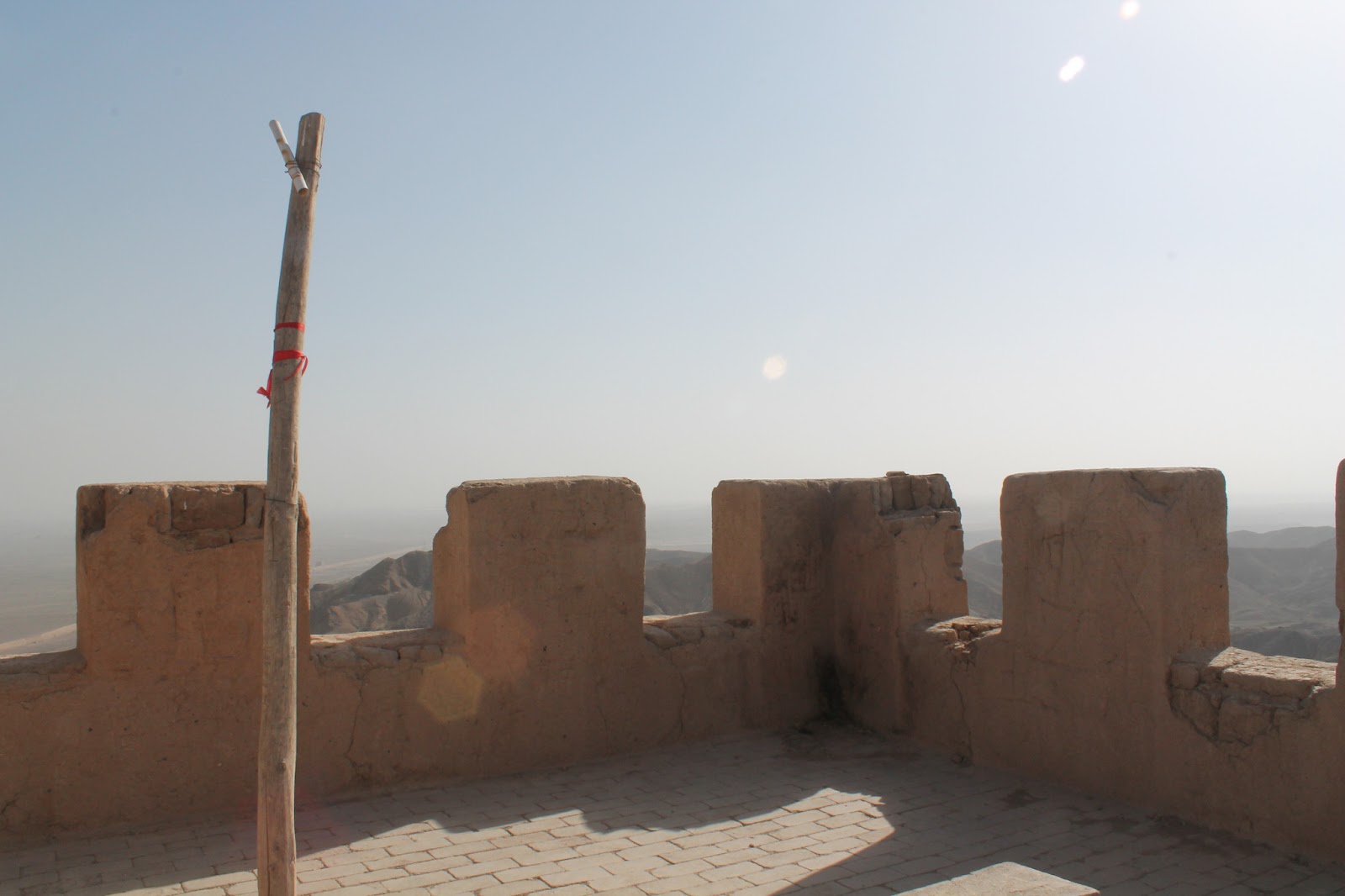
I was the only living soul in the vicinity of the wall except for one man, sleeping behind the ticket counter, on a makeshift cot. I guess I was his first customer. He charged me the student rate of 10 kuai without looking at my ID (which was cool of him), and I started my ascent. About 20 minutes later, a Chinese man hopped out of a taxi and followed me up at some distance. The wall had been reconstructed in most places but not all of it had and the location was genuine and this location was half the fun, so the wall was actually really nice. I had been to one of the other ends of the great wall, the southern portion outside Chengdu, and it was summer and crowded and the wall was reconstructed and it was almost no fun at all. Here, in Jiayuguan, I was nearly alone, in the quiet solitude of the mountains, with the desert in the distance and the Hexi Corridor (the funnel between mountains that leads the silk road west) in view. I made it to the top (and the end) and sat for awhile staring out at the view beyond. I needed the breather.


A view of the end from below


The end of the Great Wall is glorified by a mighty stick
The Chinese man caught up with me eventually and, after several minutes of panting followed by several minutes of snapping photos, he asked me if I spoke Chinese and then we chatted awhile. He was a young guy in his early twenties and I didn’t catch his name. He was on holiday from work and headed home from Urumqi to his town somewhere near Lanzhou, with a stopover here in Jiayugaun for the day. When asked, he described his job title in Urumqi as “gongren (工人)” which just means worker. But it really means the all-purpose worker or the common man’s job. He could have been a construction worker, factory worker, coal miner, whatever was needed at the time, and like the gentlemen from the train out of Dunhuang, he goes wherever there is work - this time, Urumqi. Since he had taken a cab, he was short on time (another reason I hate cab for hire's - they are in a rush to get you in and out) and left. I, however, headed to the other portion of the end of the great wall. Fearing the other was the “real” end and not the first one I climbed, I decided to climb both. This one was nice too, I took more photos from the top, and then descended the equally deserted wall to the road below back into town. 


My ascent


View of the mountains from the top of the second end of the Great Wall
I again decided to refuse taxis (there weren’t any anyway) and walk but, somewhat dreading the long, slow walk back, I decided I would give hitch hiking a go for the first time in my life. In a place like this, I think hitch hiking is reasonable. The single road into town through country side was deserted. No shops for water, no places to go, no taxis and it winds through a village for part of it. So I decided that (since I heard that usually people only stop for hitch hikers for an exorbitant fee in China, thinking they will pay because they are in need), I decided to refuse anybody who wouldn’t take me for 5 kuai considering I had the time to walk the two hours if need be. The first car that came by drove right by me but following the car was a motor bike who stopped, told me to hop on the back, and said he was headed in the same direction. He didn’t ask for money. He just asked where I was from and if I was traveling. The ride was great (maybe a little (a lot) cold). We whizzed by farms, I had the chance to look around at the factories belching smoke on the horizon, I had never been on a motor bike before. He dropped me off at the fort where I could catch the 1 kuai bus into town (I asked him to take me here) and then he told me he hoped I have a good time traveling in his country and that was it. No money, just a super cool guy doing something nice for a traveler. That made my day.

I hopped the sleeper train to Lanzhou last night. We left at 9 PM, I found my berth (a lower berth for the first time, it was very nice), and the cabin attendants made it lights out at 10. Everyone was asleep immediately. We arrived in Lanzhou at 7 this morning and considering I hadn’t showered in days and was lugging around my stuff, I picked the first hotel I saw (there are no hostels in this city either) and went in. It’s expensive, comparatively expensive at 169 kuai per night. But this is my last stop before Beijing and I need the rest. This is an actual hotel room with a shower and a sink and a toilet and a bed with blankets and pillows and probably the most exciting thing, free internet for the first time in days (and my VPN is working). So this is a real-time post.

Lanzhou, which I will explore shortly, is a city that is not really famous for anything except its noodles and its bridge. The city is cut in a half the long way, in this skinny, elongated city, by the famous Yellow River. The bridge, I’m told, was built by Germans a hundred years ago and is worth checking out. The noodles are indeed a specialty. You can find them around the rest of China on menus and are called “lanzhou niu rou mian (兰州牛肉面)” which just means Lanzhou beef noodles. But the noodles are made from these specialists who take the raw dough, roll them into huge elongated strands, and pull them over and over again, flipping, throwing, and swinging them in the air. Then they roll it all back up into a dough ball and start again. They do this in the front of the shop so passers by can watch. Eventually they get what is called “la mian (拉面)” which just means pulled noodles and then they mix them with beef and vegetables. It is really good and I look forward to trying them at their source.

Best of Dunhuang

(Please back date to 1/29/13)

Today was a bit of a lounge day. In fact I was able to connect my VPN for a total of three hours before it quit on me this morning but the good news was that I was able to post my old blog entries from the last week or so (barring tonight’s). I was hoping for access all day because I have some messages to respond to and even more importantly, my Chengdu film is finished and I want to post it to Vimeo - the audience awaits after all! I suspect Beijing will be my first opportunity to get everything connected to the world.

Apart from my frantic VPN extravaganza this morning (sorry, let me explain VPN really quickly. VPN is basically my way for cheating the system that is the communist death grip the Chinese government has on free internet use in the mainland. Normally, China restricts the use of such websites as Facebook, Google’s Blogger (this blog), Youtube, Vimeo, etc. This is annoying for expats living in China who sort of rely on these sites to stay connected to friends and family at home. Well, VPN is basically an anonymous network (or not anonymous if done through a company or school) of servers around the world that you can link into in order to bypass Chinese servers that have firewall blockers on certain sites. VPN costs a marginal fee. It’s worth it. Please revert to the beginning of this paragraph...) I decided to walk around the town and do such functional chores as finding the train station, buying tickets for tomorrow to Jiayuguan, buying things for the train ride, stuff like that. It was relaxing. And to be honest a good way to see the town.

So, nothing exciting today. But I did just get back from a fun dinner experience. I and Alenka, my Czech friend and Dunhuang travel buddy from the hostel, went to get some dinner but it was pretty late. There is an outdoor market nearby that is active during the day. They have stalls and tables where people sell meat, fish, nuts, berries, spices, naan, all kinds of good things and there is an alleyway off the market that is crammed with specialty shops. Apparently, each of these shops (actually, they’re restaurants with one or two tables each), specializes in one type of dish. Maybe soup, maybe noodles, maybe rice, roast meat, whatever. Well, it was late and all the stalls and tables had already packed up and most of the shops were closed except a few. We walked past one and this middle aged woman with a thick Chinese accent pops out behind the heavy curtain of a door and says, “Lai! Nimen chile ma? (来!你们吃了吗?) Come, come, come! You eating?” We hesitantly approached and looked at the menu posted outside the door (all in Chinese characters so we recognized some things, but not all of it). Some things looked good. Mostly, everything was various types of fried noodles. The woman, smiling, said, “Ni chi shenme, ah? (你吃什么,啊?) So, what are you eating? Eh?” She was a plump woman and was waving a wooden ladle - I’m not sure why she had a ladle, she wasn’t the cook. Alenka asked her what her specialty dish was, what was good there (she also studies Chinese). She replied, “Mian! Mian haochi. (面! 面好吃.) Noodles! The noodles are good.” We laughed. There was a list of at least 20 things on her menu. I pointed to something. How is this one? “Nage meiyoule. Mian haochi. (那个没有了。面好吃.) No, we don’t have that. The noodles are good.” Oh, ok. Well, how about this one? Is this good? “Hahaha, (she chuckled in a plump, endearing way) Nage ye meiyou. You mian! Tese shi mian! Ni chi mian. Lai, lai, lai...(那个也没有了。有面!特色是面!你吃面!来,来,来...) No none of that either. We have noodles, our specialty is noodles, you are eating noodles, come, come, come...”

So we ate noodles. They were pretty good.

Tomorrow I’m on a five hour train ride to Jiayuguan. I’ll spend one night there and hop my overnight train to Lanzhou. I’ll leave you with part two of my best of series: best of Dunhuang. Enjoy!


A blue sky above the grottoes

A snow-swept landscape across from the grottoes

Facade of the cliff that houses the Mogao caves

The group I traveled with from the hostel

My compatriots over a breakfast of steamed buns before our trip to the desert

Alenka and Yuan in the sandbox

We tried to get a group shot utilizing the photo delay function - I don't know how it turned out.

Dusk over the dunes

Our hiking path

Sand dunes the size of mountains - our shadows for size comparison

Camel caravan traversing the desert

The Great Migration

(please back date to 1/30/13)

quick note: I messed the order of posts up (rotten back dating!) and I don't know how to change it so please read this after "The Best of Dunhuang"

I woke up early this morning to check out of the hostel in Dunhuang. I picked up the local bus and drove the 30 minutes to the train station. Dunhuang has the biggest, nicest one-track train station I have ever seen and the only Chinese station that I have ever been to that I didn’t either feel like a refugee in a refugee camp, or cattle being herded into pens. I’ll explain. Most Chinese train stations are so crowded and every train, everyday, everywhere is sold out (including standing only tickets). So the stations become mobbed with people. And trains in China are “the people’s” mode of transportation so the majority of passengers are middle to lower class families. These families bring, what seems like, their entire stash of household goods whenever they travel and they all use either used grain bags as luggage, or these huge, cheap denim bags. I’m not sure where they get them but they all have them. These families arrive to the train station a few hours prior to departure and set up shop wherever there is room: in seats, on the floor, on top of garbage cans, wherever there is space. Train stations are also filled with beggars and thieves. They are precarious places. And you feel like cattle because, in order to control the people and ensure they don’t storm the gate riot style in order to get on to the train first when the train arrives (since there are so many people, even though your seat is guaranteed, space for your luggage isn’t so it behooves one to get on the train first), train station employees pen the different rows of seats in the huge waiting halls with lock and key barriers. So you feel like cows.

Dunhuang on the other hand was not crowded at all and the station was quiet, spacious, and clean. Good on you, Dunhuang!

I got onto my train and, like the station, the train was uncharacteristically spacious, having a few empty seats here and there. What was interesting is that on this particular train, all (or most) of the passengers were clearly lower class workers. All of them middle aged men. My entire car was filled with them. You could tell that they were workers based on their dress, mainly army jackets and pants and heavy workboots, and the fact that for the most part, they traveled with just the clothes on their backs. It is as if they all just finished a job in Dunhuang and were now being transported to another location to start another job. I do know that these workers tend to come from all over the country and I’ve seen in many instances that they live in make shift quarters on their particular job site. They stay and live in the job and then move on to the next job when they finish. I suspect this was the case here. Each man also had a distinct cough: a wet, heaving cough from the lungs that I would think is typical of people who are both chain smokers and workers of heavy industry. They also had the glassy eyes you’d find amongst alcoholics and in fact they were passing around bottles of baijiu (local grain alcohol) once the train started rolling. The workers around me were all pretty quiet and slept for most of the journey but the group a few rows down from me were all shouting at one another in voices three times the appropriate volume as they played cards and drank. It wasn’t a bother to me but it was for the people near them. Really interesting passengers today.

Another weird occurrence on the train that I have never experienced before is that after we left the station, a police officer came around to check everyone’s identity cards. In China, every person is required to maintain an identity card much like we (as in we in the US) have driver’s licenses that we also use as common ID’s. However, Chinese identity cards each have a unique bar code and the policeman that walked around had a scanner that could scan the bar code of the identity card and pull up information on that passenger on his display. Except this had nothing to do with train passenger information. I believe he was doing a sweep of the train looking for criminals or anyone that may have been flagged on a police list. He didn’t know what to do with my passport.

I pulled into Jiayuguan station around 2 in the afternoon, hopped the local bus, and checked in at the cheapest hotel I could find (based on the Lonely Planet recommendation). I am now staying in a double-bed room in a small Chinese hotel (there are no hostels here) and there is no bathroom or shower or sink or any facilities of any kind. The hotel does have a common bathroom in the lobby but the men’s room is always locked. Soooo, I’m not sure what’s going on with that...

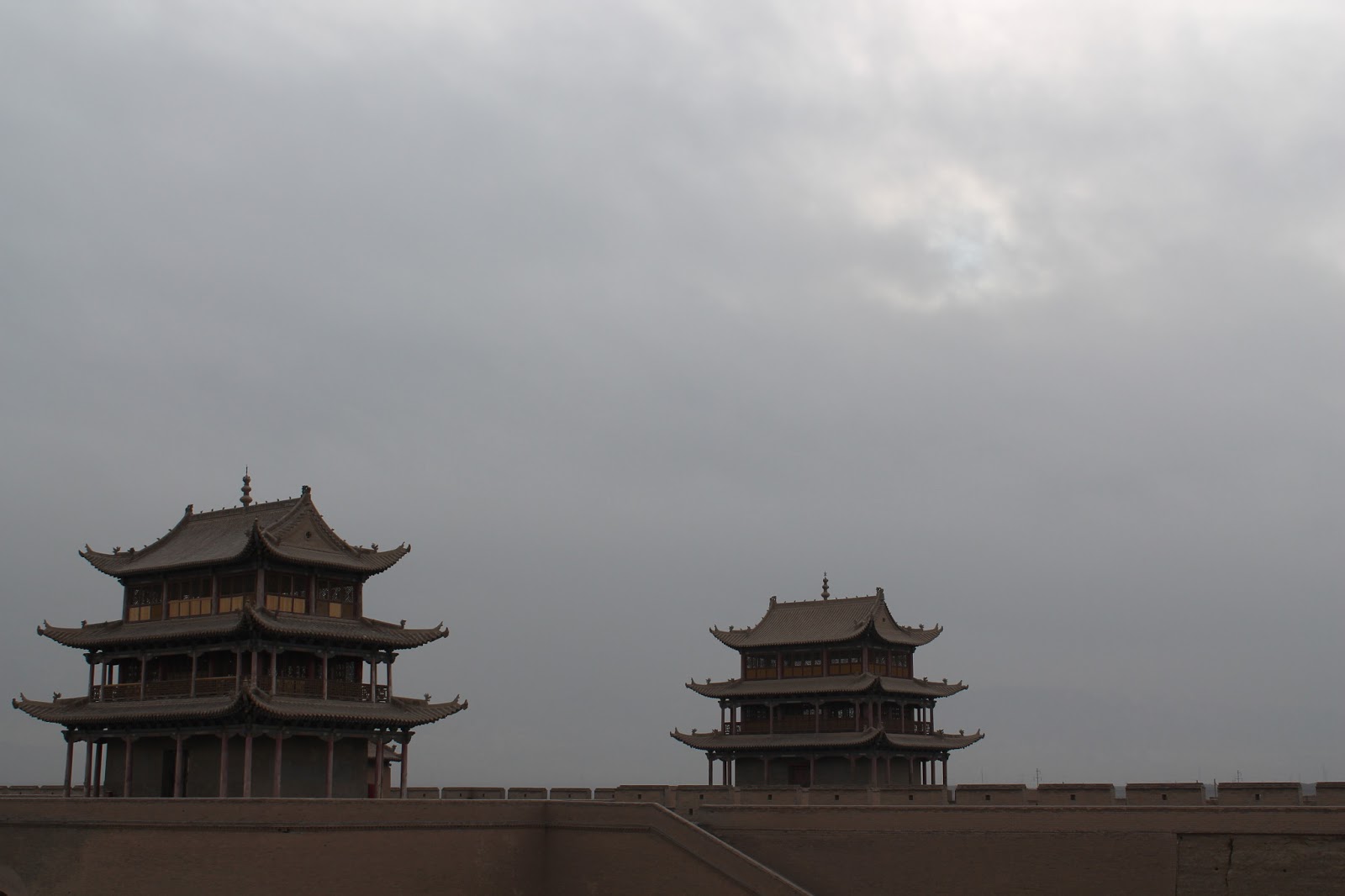
I did arrive in Jiayuguan in time to take a trip out to the Jiayuguan Fort. I mainly came to Jiayuguan as a quick stopover before heading southeast to Lanzhou and then to Beijing. But I picked this place as a stopover specifically because this is the site that the Ming Dynasty decided to call the “edge of the Han empire” beyond which lies the wilds of the west. This is also the location of the end of the northern section of the Great Wall. During the Ming Dynasty, about 600 years ago, they built a giant fort which was the last Han foothold going west. They posted military members here to protect the passage east from the various tribes and nomads of the west. It was well known that if you took the road from here further west, you were likely to be ambushed and killed by raiders if you didn’t first succumb to the demands of the desert terrain. There are also several accounts of historical clashes between the Han generals and the tribal kings of the Uighurs and other Central Asian clans. A place wrought with history. This fort is set in the midst of a lunar landscape and on the fringe of two mighty, snow capped mountain ranges that create this funnel of a desert passage to this west. So it was a strategic spot. It was also beautiful today (apart from the clouds) because the area is still completely undeveloped apart from a few distant factories and the little town of Jiayuguan about seven kilometers down the road. So it still feels genuinely like the end of the Chinese empire. For centuries, the empire used to exile people through the west gate of this fort. Apparently, they gave whomever they were exiling a horse and some minor provisions and made them trot away to the west, never to return to the Middle Kingdom. This place was very cool and completely worth the stopover. Fun fact: this is also the area in which part of Zhang Yimou’s movie “Hero” is based (and was filmed) for you movie buffs out there.


Pagoda and lake in the foreground of the fort
Gate to the east and gate to the west


The general's quarters

View of the wild west beyond the last gate of the fort

Another train ride tomorrow. This time, the overnight to Lanzhou. See you there!